Chase Cooper—Shannon Watts
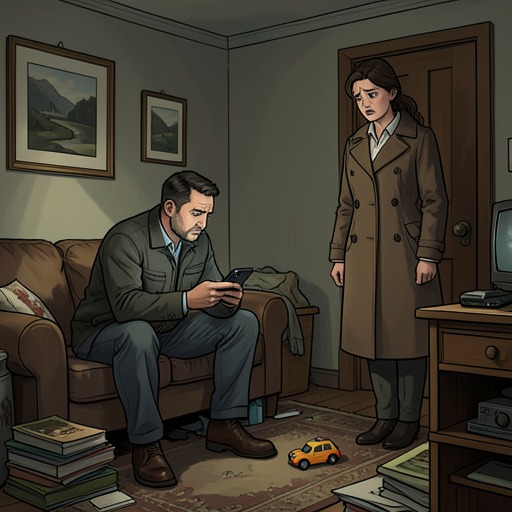
The Birthday PartyChase Cooper’s marriage to Shannon Watts is a past relationship that returns as a practical and emotional complication: she turns up at his home years after leaving town, but his concern for Patrick does not amount to renewed commitment to her. Their history is marked by Chase’s lingering comparison with Kathy Hamilton, Shannon’s affair with Luke Phillips, and Chase’s stronger attachment to the child than to the marriage that brought him into Patrick’s life.
Beginnings and Marriage
Chase began dating Shannon after Kathy rejected him. Looking back, he considers himself young and foolish to have become involved, though he does not regard the relationship as wholly bad. The decisive comparison is that Shannon was not Kathy. His recollection makes clear that his marriage began in the wake of an earlier disappointment rather than with the same emotional importance he assigns to Kathy.
The marriage nevertheless became a consequential bond. Chase took on a substantial role in Patrick’s early life, spending more time with him than Luke, Patrick’s biological father. That history helps explain why Shannon’s later departure affects Chase most acutely through his separation from the boy. He remembers missing Patrick much more than he missed Shannon, distinguishing his attachment to the child from his feelings about his former wife.
Betrayal and Patrick’s Paternity
Shannon had been seeing Luke behind Chase’s back, and when she became pregnant she tried to pass the baby off as Chase’s. Chase says he would have believed her if Luke had not insisted on a DNA test. The test exposed that Patrick was Luke’s son, not Chase’s, and established the paternity that had been concealed from him.
Even after learning about the affair and the attempted deception, Chase did not immediately make Shannon leave. She was pregnant, and he regarded her as vulnerable and unable to care well for herself. His response complicates his later bitterness: he remembers the betrayal clearly, but also recalls making room for Shannon rather than turning her out at a moment when she was especially dependent. His resentment remains, yet it coexists with a record of care and reluctant responsibility.
Shannon later left town with Patrick and no forwarding address. Five years have passed by the time she contacts Chase again. Patrick was three when she took him away and is now about eight. Chase believes the boy may no longer know who he is, despite the time they spent together before the departure. Their separation leaves Chase with no ordinary access to Patrick and no assurance that the child remembers him.
Shannon’s Return and Chase’s Boundaries
Shannon’s return is abrupt: she calls Chase while he is occupied with work, then tells him she is outside his home and that she and Patrick need somewhere to stay. Chase refuses to house them. His first response is not an offer to restore the marriage, but a reminder that Luke is Patrick’s father and might take them in. Shannon’s lightness about their long silence and her appeal for help sit alongside the unresolved history between them, including the affair she acknowledges Chase has not forgotten.
When she says she has already let herself into his home with a key she still possesses, Chase is annoyed that he never changed the locks. The key gives her access to his house, but it does not signify that he has agreed to welcome her back as a partner. The scene instead exposes a boundary that was never fully secured: she can enter his home, while he remains opposed to her staying there.
At the police station, Luke confronts Chase after hearing that he and Shannon are back together and objects to being kept from Patrick. Chase corrects the rumor: Shannon appeared unexpectedly and let herself into the house; he did not invite her back. He confirms that Patrick is with her, then offers Luke the chance to visit his son when Chase is home to let him in. The offer redirects the conflict away from competition between the two men and toward Patrick’s relationship with his father.
Care, Resentment, and the Meaning of the Reunion
Chase’s conduct separates his attitude toward Shannon from his concern for Patrick. He refuses to take Shannon back and has asked her to leave, but tells Luke that his problems with Shannon are not Luke’s concern and that Patrick needs his father in his life. His decision to facilitate contact is particularly significant because Luke’s insistence on a paternity test once exposed Shannon’s deception. Chase does not let that history become a reason to deny Patrick access to Luke.
The return therefore produces neither reconciliation nor a simple continuation of the old marriage. Chase’s resentment is plain in his reference to Shannon’s infidelity, and his refusal to provide a home establishes that the relationship is over in practical terms. At the same time, the years he spent caring for Patrick leave a durable attachment that survives Shannon’s disappearance and shapes his choices when she comes back. The distinction between biological fatherhood and lived parental care becomes central: Luke is Patrick’s father, while Chase has also occupied an important place in the boy’s life.
The narrative presents this history through Chase’s close perspective, moving from the unexpected call at home to Luke’s challenge at the station. The change of setting turns private assumptions into an explicit misunderstanding: others infer a renewed romance, while Chase states that he has no intention of resuming it. What persists is not the marriage but the unresolved family connection created by his years with Patrick—and Chase’s effort to keep the child’s needs separate from the adults’ past.